

Mechanical anchors transfer load into concrete by friction from expansion or by mechanical interlock with a recess or thread. Chemical anchors, also called bonded anchors or chemical fixings, transfer load through a bonding mortar, usually an injected resin, between a steel rod and the hole wall. The choice affects when the anchor can be loaded, which embedments are available, how close to an edge it can be set, how sensitive it is to installation and how it behaves under temperature and sustained load.
| Consideration | Mechanical anchor | Chemical anchor |
|---|---|---|
| Time to loading | Immediately after setting | After the curing time for the concrete temperature |
| Embedment | One or more fixed embedments per size | Often variable within an assessed range |
| Setting near an edge | Expansion pressure can split the concrete | No expansion during setting |
| Hole preparation | Diameter, depth and removal of drilling dust control setting | Cleaning and hole condition control bond |
| Temperature | Little effect on setting | Affects working time, curing time and bond resistance |
| Sustained tension | No creep of a bonding material | Bond resistance reduced in design according to the sustained part of the load |
The table describes typical behaviour; the European Technical Assessment (ETA) of a product establishes its conditions of use and resistances.
Time to loading
A mechanical anchor develops its anchorage during setting. A throughbolt is expanded by tightening, a drop-in anchor by a setting tool and a concrete screw cuts its thread as it is driven. Once installation is complete, the anchor can be loaded.
A bonded anchor must remain undisturbed until the mortar has cured. The curing time increases as the concrete temperature falls, and a fast-curing mortar shortens it at the cost of a shorter working time for injection and rod insertion. The comparison is therefore between complete sequences, from drilling to loading, at the site temperature.
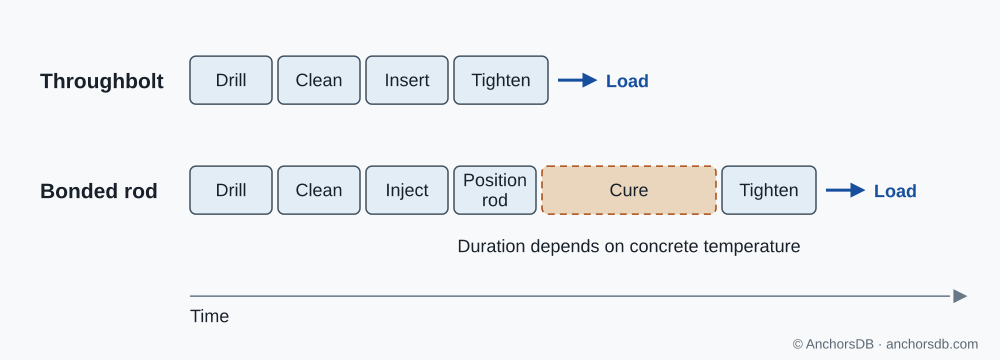
Figure 1. Installation sequences from drilling to loading. Step durations are schematic.
Available embedment
Injection systems commonly permit any embedment within an assessed range, which allows the embedment to be matched to the required resistance or the available member thickness. Capsule systems tie the embedment to the capsule size. Mechanical anchors have one or more assessed embedments per size, each with its own installation dimensions and resistance data.
A deeper embedment increases the concrete cone and bond resistance but not the steel resistance, and it requires a correspondingly thicker member. See anchor dimensions and notation for embedment, hole depth and member thickness.
Edge distance and member width
An expansion anchor presses outwards against the hole wall during setting. Near an edge or in a narrow member, this pressure can split the concrete before any load is applied. The minimum edge distance, spacing and member thickness in the ETA are set to prevent this.
A bonded rod is set without expansion, so no setting pressure acts on the hole wall; splitting forces during installation arise only from the installation torque and are smaller than those of expansion anchors. Bonded anchors are therefore often suitable for narrow upstands and fixings close to an edge, within the minimum distances in their ETA. Under load, a bonded anchor still introduces stresses into the concrete and is subject to its own minimum distances and splitting checks. Undercut anchors and concrete screws engage the concrete by bearing and have their own requirements.
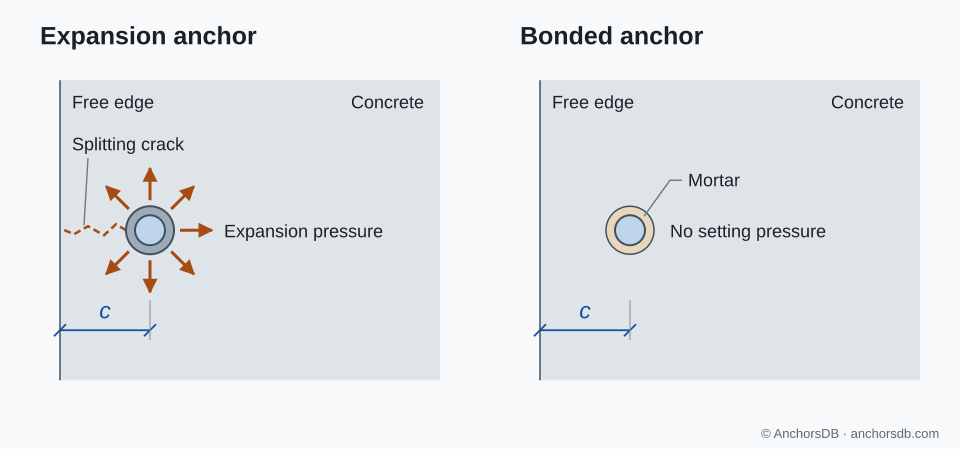
Figure 2. Stresses during setting at the same edge distance. Both anchors introduce stresses into the concrete when loaded.
Near an edge, both types also lose concrete available to resist load. Shear directed towards the edge can make concrete edge failure govern, however high the steel resistance; see how concrete strength and geometry affect anchor resistance.
Installation requirements on site
- Torque-controlled expansion anchors: access for a torque wrench and the specified installation torque.
- Drop-in and undercut anchors: the specified setting tool or recess-forming and setting operations.
- Bonded anchors: cleaning of the hole wall, which forms part of the bond. Retained drilling dust reduces bond resistance, so the cleaning method and access to the bottom of the hole are critical; deep holes can require cleaning and injection extensions. Systems assessed with hollow-bit drilling and dust extraction can use a different cleaning procedure.
Hole condition also limits the choice. An injection mortar assessed for dry, hammer-drilled holes may have different data, or none, for water-filled or diamond-cored holes. The condition on site should be established before resistance values are compared. See drilling methods and hole cleaning.
Temperature, sustained loading and service conditions
Temperature affects a bonded anchor at two stages. During installation, it determines the working and curing times; in service, the bond resistance decreases as the temperature of the mortar rises. The ETA gives resistances for defined temperature ranges.
Under sustained tension, the mortar deforms slowly by creep. The ETA gives a factor for this effect at the relevant service temperature, and EN 1992-4 reduces the bond resistance according to the proportion of the load that is sustained; this matters most for permanent tension near a heat source.
Both mechanical and bonded anchors are available for cracked concrete; the product must be assessed for the concrete condition at the anchor (see cracked vs uncracked concrete). Where fire, seismic or fatigue resistance is required, the data for that loading must be compared.
See throughbolt expansion anchors and resin bonded anchors for the installation and load transfer of each type.