

An anchor required to carry load during a fire must do so while its steel, the surrounding concrete and any bonding mortar lose strength as they heat. Fire resistance is stated as the duration for which the fastening carries its load under the standard temperature–time curve of ISO 834-1, classified as R30, R60, R90 or R120 to EN 13501-2. EN 1992-4 verifies the same failure modes as at ambient temperature, using resistances under fire exposure from the European Technical Assessment (ETA) and loads from the accidental load combination of EN 1990.
Heating of the anchor and the concrete
The fixture, nut and projecting part of the anchor are heated directly. Steel conducts heat well, so the anchor reaches nearly the temperature of the fixture: anchors with small diameters heat fastest, and a massive fixture delays heating during the first part of the fire. In the first 30 to 60 minutes, water evaporating from the concrete, particularly at cracks, temporarily cools the steel.
The concrete heats from the exposed face, and its temperature falls rapidly with depth. Concrete strength begins to decrease at around 100 °C, so the concrete near the surface contributes less resistance as the fire continues. The heated surface expands and is restrained by the cooler interior, which closes surface cracks but can open wide cracks inside the member. Explosive spalling of the surface concrete is most likely with high moisture content, high compressive stress and high-strength concrete; EN 1992-4 requires it to be prevented or taken into account in the design.
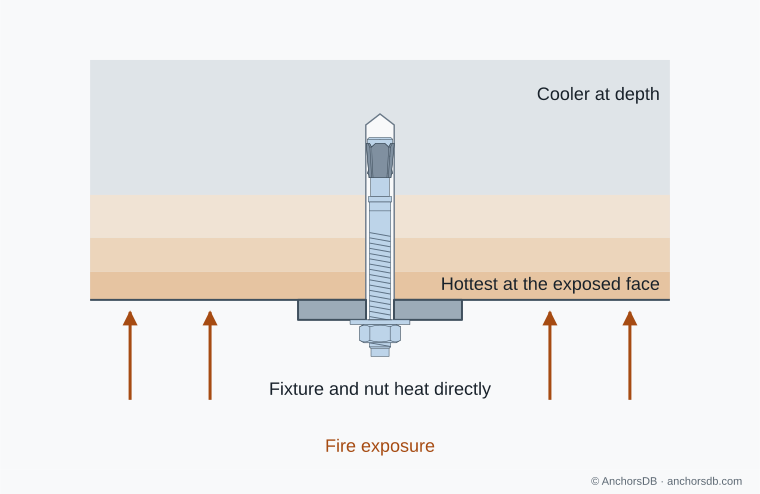
Figure 1. Heating of an anchor in a soffit exposed to fire.
Failure modes under fire exposure
The characteristic resistances under fire exposure are taken from the ETA. Where the ETA gives none, Annex D of EN 1992-4 provides conservative values for anchors in concrete classes C20/25 to C50/60, based on the resistances in cracked concrete at ambient temperature.
| Failure mode | Conservative value in EN 1992-4 Annex D |
|---|---|
| Steel failure, tension and shear without lever arm | Characteristic strength of the unprotected steel, from 10 to 30 N/mm² at 30 minutes and 5 to 16 N/mm² at 120 minutes, depending on diameter and steel |
| Pull-out of mechanical anchors | 25 % of the pull-out resistance up to 90 minutes; 20 % up to 120 minutes |
| Concrete cone failure | times the concrete cone resistance up to 90 minutes, with in mm; 0.8 times that value up to 120 minutes; characteristic spacing |
| Pull-out of bonded anchors | No conservative value; determined by fire tests for the product |
| Pry-out | times the concrete cone resistance under fire |
| Concrete edge failure | 25 % of the edge resistance up to 90 minutes; 20 % up to 120 minutes |
| Splitting and blow-out | Not verified |
Steel failure usually governs for unprotected anchors. The tabulated steel strengths are a few per cent of the strength at ambient temperature, which is typically 500 to 800 N/mm². Stainless steel of grade A4 retains more strength than carbon steel, and larger diameters retain more than small ones. Anchors for suspended ceilings, which have short embedments in the heated surface concrete, still generally fail in the steel when unprotected.
The concrete cone resistance decreases less at greater depth: up to 90 minutes, an anchor with 100 mm effective embedment retains half its cone resistance, and one with 200 mm retains all of it. The concrete cone also becomes larger in a fire, so the characteristic spacing increases from to .
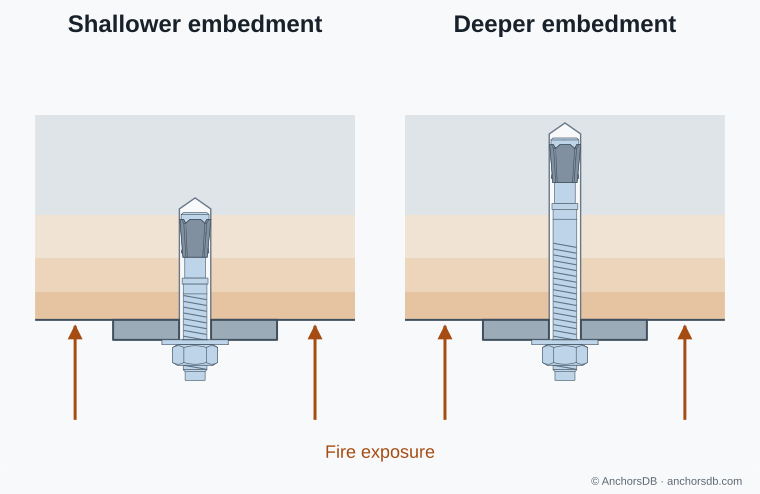
Figure 2. Embedment depth and the heated zone.
The mortar of bonded anchors loses strength considerably above about 80 °C, and its behaviour at high temperature is specific to the product. The ETA gives a reduction factor for the bond strength as a function of temperature. EOTA TR 082 combines it with the temperature distribution along the embedment, either using the highest temperature along the bond length or integrating the bond resistance over the embedment. Deeper embedment places more of the bond length in cooler concrete.
Conditions of the fire design
The design method of EN 1992-4 applies to anchors with an ETA for use in cracked concrete and to fire exposure from one side. Where the fire acts on more than one side, it applies only if the edge distance is at least 300 mm and at least . The recommended partial factor for resistance under fire exposure is 1.0, multiplied by the installation safety factor for concrete failure modes under tension. EN 1992-4 assumes that the fire resistance of the fixture is adequate. Cladding, coatings and concrete encasement reduce the steel temperature and can increase the fire resistance.
Fire exposure is an accidental design situation; elevated service temperatures, which affect bonded anchors in normal use, are covered in sustained loading, creep and fatigue. For resistance terminology, see characteristic, design and recommended loads, and for seismic loading, anchors under seismic loading.