

A bonded anchor transfers load from the steel element through hardened mortar into the wall of the drilled hole. Drilling dust left on that wall forms a weak layer between mortar and concrete, and the bond then fails within the dust layer at a lower stress. Cleaning removes the layer so that the mortar bonds to sound concrete. The bond resistances in the European Technical Assessment (ETA) apply only to holes cleaned by the procedure it specifies.
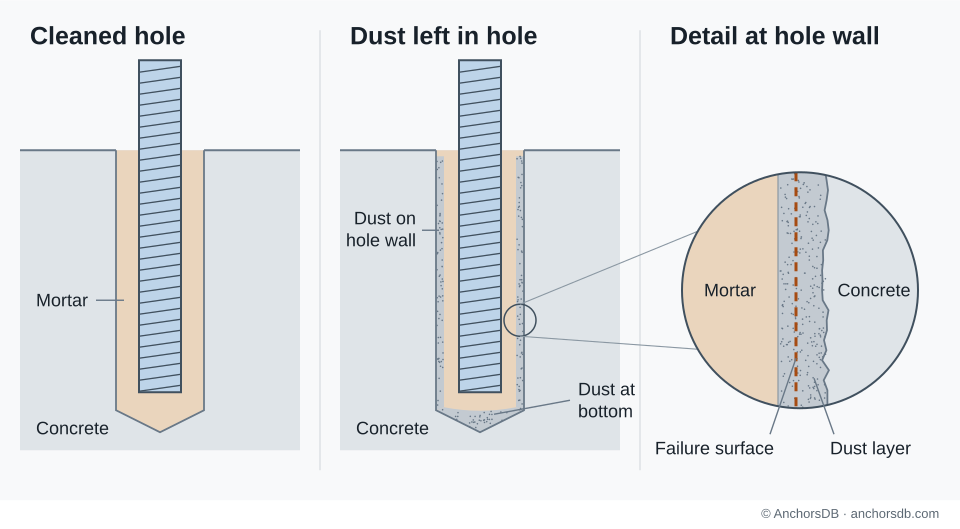
Figure 1. Cleaned and uncleaned holes, with the wall interface magnified. Dust layer thickness exaggerated.
Effect of drilling dust on bond resistance
The loss of resistance in an uncleaned hole depends on the resin and the anchor system. In tests on M12 injection anchors in dry, uncracked concrete, omitting cleaning reduced the tension capacity by less than 20 % for some resins and by up to 50 % for others; in cracked concrete, reductions of up to 60 % were recorded. Spin-in capsule systems are among the least sensitive, because the rotating rod and the quartz filler in the capsule scour dust from the hole wall. Torque-controlled bonded anchors are also less affected: when the bond is disturbed, the conical sections of the rod pull further into the hardened mortar and press it against the hole wall.
EN 1992-4 accounts for this sensitivity through the installation safety factor given in the ETA. For bonded anchors, the factor is derived from tests that include reduced hole cleaning; a product sensitive to cleaning receives a higher factor and therefore a lower design resistance.
Cleaning of hammer-drilled holes
Hammer drilling leaves loose dust in the hole and a fine layer adhering to the wall. Blowing removes the loose dust, and brushing detaches the adhering layer so that the final blowing can remove it. A typical sequence is:
- Blowing from the bottom of the hole.
- Brushing over the full hole depth.
- Blowing from the bottom again.
The ETA and installation instructions specify the number of blowing and brushing operations, the brush diameter and material, and the blowing equipment. A hand blow pump is limited to a hole depth and diameter given by the manufacturer; deeper or larger holes, such as those for post-installed rebar, require oil-free compressed air, because oil impairs resin adhesion. Nozzles and brushes need extensions to reach the bottom of deep holes.
The bond resistance in the ETA reflects the brush used in the tests. A steel brush removes more dust than a nylon one, so a nylon brush used where a steel brush is specified reduces the bond. A worn brush that no longer contacts the hole wall, fewer brushing operations than specified, and dust left at the bottom of the hole before brushing have the same effect.
Where the ETA covers hollow-bit drilling, dust extraction during drilling can replace the separate blowing and brushing; see drilling methods for post-installed anchors.
Wet, water-filled and diamond-cored holes
The ETA states which hole conditions are covered: dry concrete, water-saturated concrete, or a hole containing standing water. In saturated concrete, drilling dust sticks to the hole wall and is harder to remove, and the water film on the wall can impair bond as the resin cures. Tests showed reductions in tension capacity from less than 20 % to considerably more, depending on the resin. Standing water in the hole reduces bond to a similar extent even in otherwise dry concrete. Some resins also need a longer curing time in wet holes.
Wet diamond core drilling leaves a smooth wall coated with slurry, and the hole stays wet for some time. The slurry is flushed out with clean water from the bottom of the hole until the water runs clear, the hole is brushed and flushed again, and then the specified dry cleaning sequence follows. After the hole has dried and been cleaned, high-adhesion resins reach approximately the bond strength measured in hammer-drilled holes; low-adhesion resins show significantly lower values on the smooth wall. Some ETAs therefore require the cored wall to be roughened with a special tool before cleaning.
For injection and curing, see resin bonded anchors.