

Anchors for concrete are classified by when they are installed and by how they transfer load. Cast-in anchors are placed before the concrete is cast. Post-installed anchors are installed in drilled holes and transfer load by friction, mechanical interlock, bond or a combination of these. This guide covers metal anchors, often called anchor bolts or fixings, for structural loads in concrete.
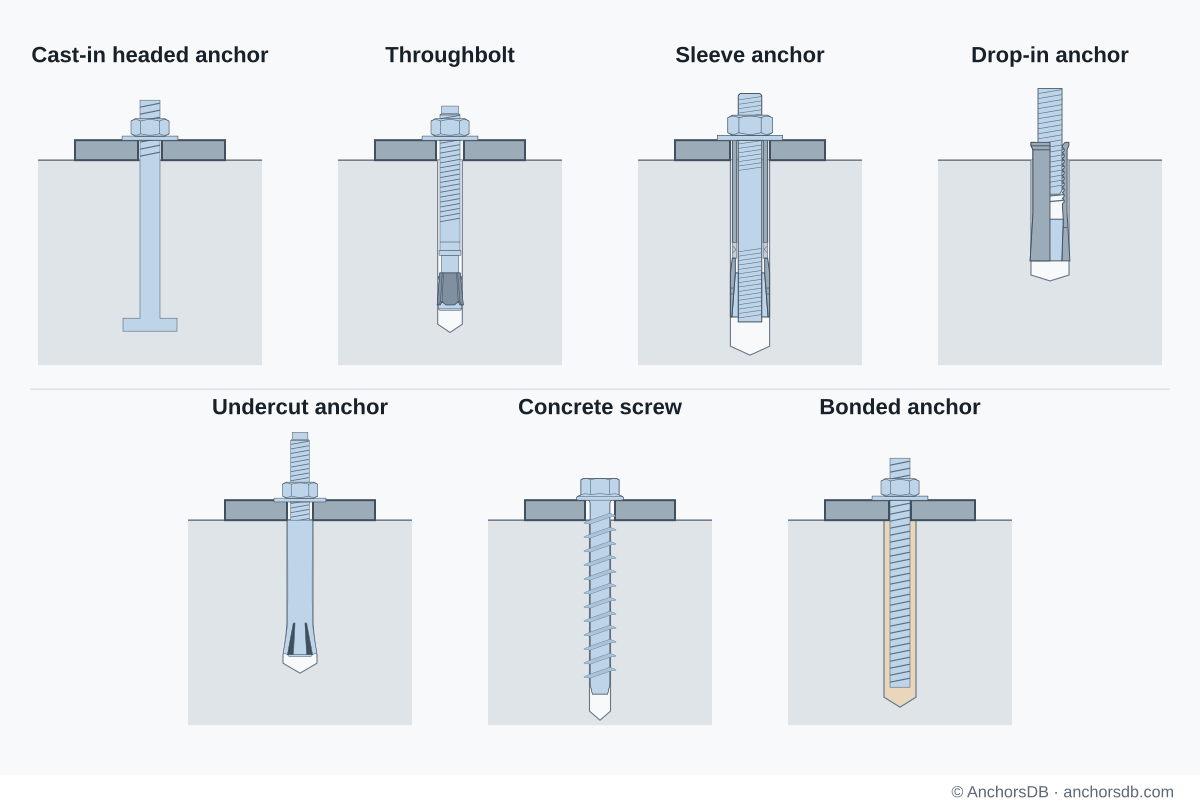
Figure 1. Common cast-in and post-installed anchor types.
Cast-in anchors
Cast-in anchors transfer load by mechanical interlock: an embedded head, anchor or plate bears against the hardened concrete.
- Headed anchors and plates with welded headed studs carry loads from a fixture through the embedded heads.
- Anchor channels are steel channels with welded or forged anchors on the back. Special bolts can be positioned along the channel, which allows fixture positions to be adjusted after casting.
Because their positions are known before casting, the reinforcement of the member can be arranged for the anchor loads. The disadvantages are the additional planning and coordination with the reinforcement layout, and the risk of incorrect placement, which is difficult to correct after casting.
Expansion anchors
Expansion anchors transfer tension by friction. During installation, a sleeve, clip or shell is expanded against the drilled-hole wall, and the resulting contact pressure resists the applied tension.
Torque-controlled expansion anchors are expanded by tightening, which pulls a cone into the expansion sleeve or clip. Under increasing tension, the cone can be drawn further into the sleeve, increasing the expansion. This follow-up expansion allows the anchor to continue carrying load when a crack opens through the anchorage, although at a reduced resistance. Only anchors assessed for cracked concrete may be used where cracks can occur.
- A throughbolt has a threaded stud with a cone at its embedded end and an expansion clip around it. It is installed through the fixture.
- A heavy-duty sleeve anchor has a bolt, a thick-walled sleeve and a separate expansion sleeve. The thick sleeve passes through the fixture into the hole, so the fixture bears on the sleeve, which provides the main steel cross-section in shear.
Deformation-controlled expansion anchors are expanded by driving an internal plug into the sleeve, or the sleeve over a plug, to a defined position. Once set, no further expansion occurs. The drop-in anchor is the common example: an internally threaded shell set at or just below the concrete surface, into which a bolt or threaded rod is screwed.
The expansion pressure produces splitting forces in the concrete. These forces determine the minimum edge distance, spacing and member thickness of an expansion anchor. Relative to their embedment, drop-in anchors require the largest minimum distances because their fixed expansion generates high splitting forces. Torque-controlled anchors need less initial expansion because of follow-up expansion.
Undercut anchors and concrete screws
Both transfer tension by mechanical interlock with a shape formed in the concrete.
An undercut anchor engages an undercut at the bottom of the hole, formed either with a separate drilling tool or by the anchor itself during setting. Its segments bear on the undercut in the same way as the head of a cast-in headed anchor, and its load–displacement behaviour is similar to that of a headed anchor in both cracked and uncracked concrete. The larger bearing area produces lower splitting forces during installation than expansion anchors, which permits smaller minimum edge distances and spacings.
A concrete screw is driven into a pre-drilled hole, and its hardened thread cuts a mating thread in the concrete. The thread flanks bear against the concrete under tension. Thread engagement depends on the drill-bit diameter and the embedment depth, so the specified drill bit and installation tool are essential. A screw can be loaded immediately after installation.
Bonded anchors
A bonded anchor consists of a threaded rod, reinforcing bar or internally threaded sleeve set in a drilled hole filled with a bonding mortar, usually a synthetic resin. Load is transferred from the steel to the mortar and from the mortar to the hole wall by bond along the embedded length. Bonded anchors are also called chemical anchors.
A bonded anchor exerts no expansion pressure during installation. It can be loaded only after the mortar has cured, and the curing time depends on the mortar and the concrete temperature. Bond resistance depends on hole cleaning, the condition of the hole during installation, the service temperature and the duration of loading, so the drilling, cleaning and curing procedure forms part of the assessed system.
Bonded expansion anchors
A bonded expansion anchor combines bond and friction. Its rod has one or more conical sections embedded in the mortar. Once the mortar has hardened, the rod is designed to move relative to it under tension, pressing the mortar against the hole wall. Like a torque-controlled expansion anchor, it can develop follow-up expansion when a crack opens.
Comparison of post-installed anchors
| Anchor type | Load transfer in tension | Set by | Can be loaded |
|---|---|---|---|
| Torque-controlled expansion anchor | Friction | Tightening to the specified torque | After setting |
| Deformation-controlled expansion anchor | Friction | Driving the plug or sleeve to a defined position | After setting |
| Undercut anchor | Mechanical interlock | Forming the undercut and expanding the segments | After setting |
| Concrete screw | Mechanical interlock | Driving into a pre-drilled hole | Immediately after installation |
| Bonded anchor | Bond | Injecting mortar and inserting the steel element | After curing |
| Bonded expansion anchor | Bond and friction | Injecting mortar and inserting the cone rod | After curing |
The individual type guides describe the installation and conditions of each system. The next guide describes the forces that act on an anchor: tension, shear and combined loading.