

An undercut anchor has segments that open into a recess cut in the wall of the drilled hole. Under tension, the segments bear on the concrete at the recess, and this mechanical interlock transfers the force into the concrete. The load transfer resembles that of a cast-in headed anchor.
Undercut anchors are used for heavily loaded structural baseplates, façade supports and equipment, including connections in cracked concrete and under seismic loading. They require control of both the recess geometry and the final position of the segments.
Formation of the undercut
- Pre-formed undercut: the recess is cut before the anchor is inserted, either by a special drill that forms the hole and undercut together or by a separate undercutting tool that enlarges the hole at a defined depth.
- Self-undercutting anchor: cutting edges on the anchor form the recess during setting, using rotary hammering or percussion from the setting equipment.
In both cases, the matched drilling and setting equipment fixes the recess diameter, shape and depth through its stops, cutting profile and travel. An undersized or misplaced recess prevents the segments reaching their bearing position.
Setting and fixture attachment
In the sleeve-and-cone arrangement in Figure 1, a matched setting tool drives the sleeve over the cone at the end of the stud, and the sleeve segments open into the pre-formed recess. The fixture is then fitted over the projecting thread and clamped with a nut and washer.
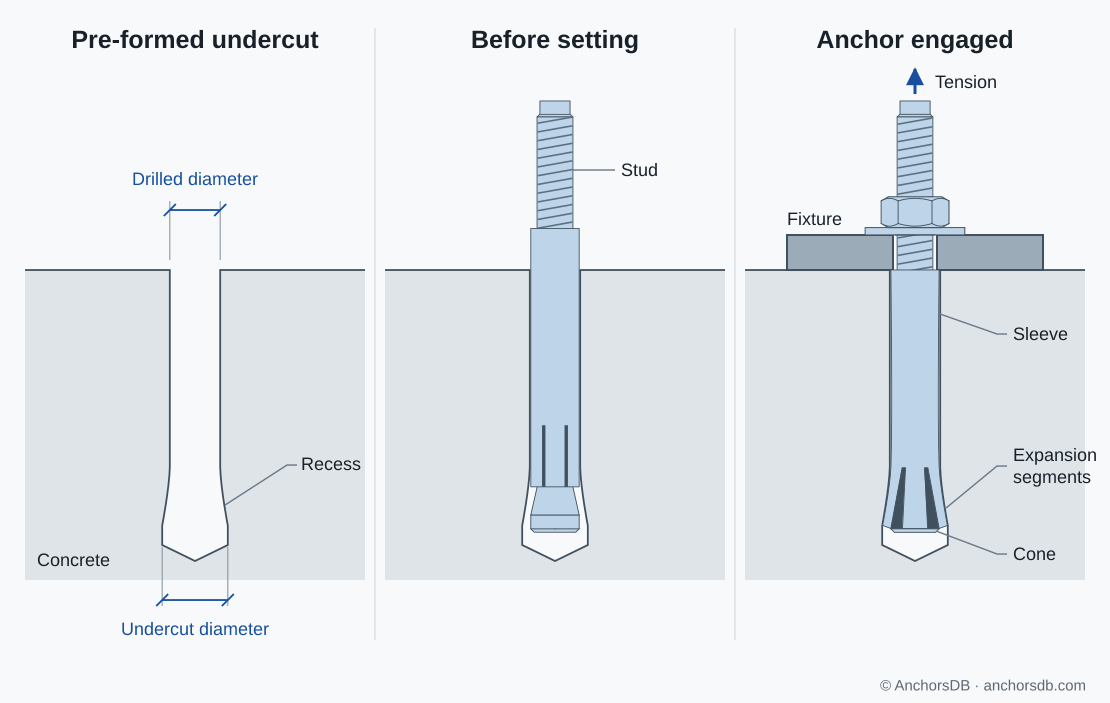
Figure 1. Undercut anchorage before and after setting.
Other versions are installed through the fixture or have an internal thread for a separate bolt. The attachment arrangement determines the fixture hole clearance and the permitted fixture thickness.
Verification of setting
The hole is drilled and cleaned as specified. Setting is complete when the system's completion indication is reached, such as a sleeve position or a mark on the stud; where the fixture will conceal it, it is checked before the fixture is fitted. For anchors whose sleeve is driven by a setting tool, tightening the nut after incomplete setting does not open the segments fully and leaves the anchor short of its bearing position.
Failure modes and concrete conditions
Under tension, the resistance is limited by steel failure, concrete cone failure, splitting or, where the bearing engagement is inadequate, pull-out. With correct setting, the bearing area is large and steel or concrete cone failure commonly governs. Under shear, steel failure, concrete edge failure or pry-out can govern.
Bearing on the inclined face of the recess produces outward forces as well as transferring tension. The minimum edge distance, spacing and member thickness in the European Technical Assessment (ETA) ensure that the surrounding concrete can resist them.
Undercut anchors are widely assessed for cracked concrete, because bearing in the recess is maintained when a crack opens. Seismic, fatigue and fire resistance require assessment data for the particular anchor and loading.