

A concrete screw, also called a screw anchor, is a hardened steel screw that cuts its own thread into the wall of a pre-drilled hole as it is driven. A headed screw passes through the fixture and clamps it to the concrete; other versions have an internal or external thread for a rod or bolt. Concrete screws are used for baseplates, brackets, rails, suspended services and temporary fixings.
Load transfer by thread interlock
The core of the screw fits inside the drilled hole, while the thread extends beyond the original hole wall. Cutting edges on the thread form a matching thread in the concrete. Under tension, the thread flanks bear on the concrete, transferring force by mechanical interlock. Because the screw does not expand, setting produces only small splitting forces.
The thread profile and cutting geometry determine the driving torque and the engagement. An oversized hole reduces the depth of thread cut into the concrete; an undersized hole increases the driving torque and can damage the screw.
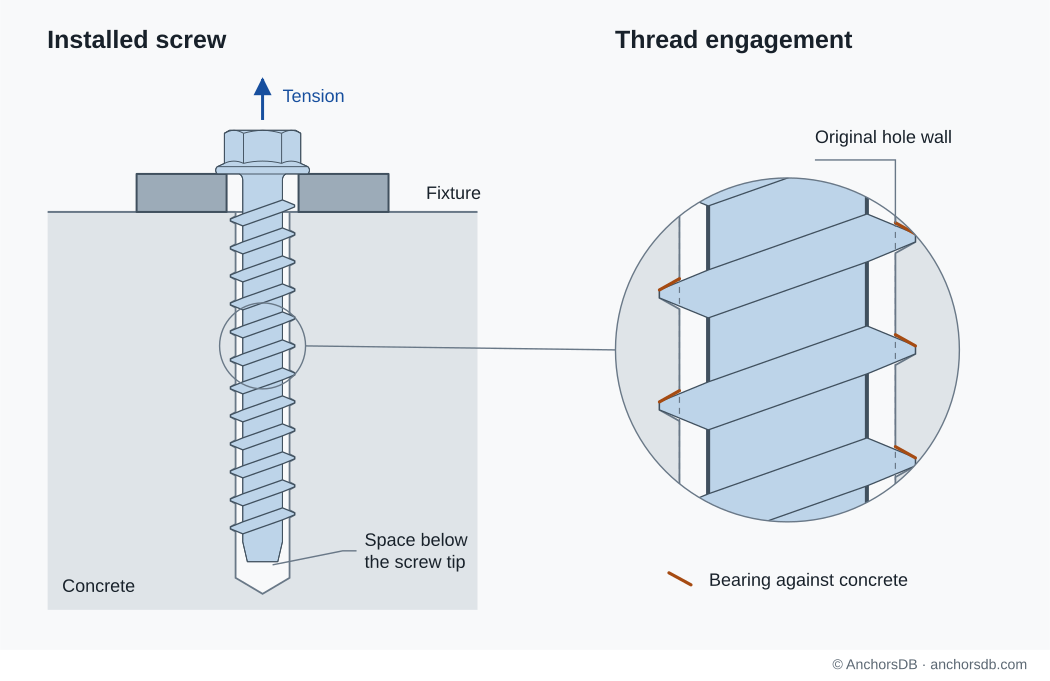
Figure 1. Concrete screw anchorage, with an enlarged thread detail on the right.
The first threads below the surface and the tapered tip transfer less load than the threads between them, so the effective embedment of a concrete screw is less than its nominal embedment. Both values are given in the European Technical Assessment (ETA) of the screw.
Hole preparation and driving
- Drilling: the hole is drilled with the specified bit diameter and drilling method, deeper than the screw tip by the specified allowance to accommodate dust from drilling and thread cutting.
- Cleaning: the procedure depends on the system. Some systems permit installation without cleaning for specified drilling methods, hole orientations and additional depths; dust retained in a hole prepared for a different procedure can stop the screw before its head reaches the fixture.
- Driving: the screw is driven with the specified impact wrench or driver until the head bears fully on the fixture. Further driving can strip the thread cut in the concrete or fracture the screw. Where a maximum installation torque is stated, it must not be exceeded.
Screw length and embedment
The screw length must cover the fixture, any washers or packing, and the nominal embedment. For a given screw length, a thicker fixture reduces the embedment.
Some screws have several embedments covered by their ETA, each with its own resistance and minimum member thickness, spacing and edge distance. The resistance data must correspond to the cracked or uncracked concrete condition at the fixing, and data for seismic or fire loading must cover the screw, embedment and loading concerned.
Failure modes and material
Under tension, the resistance is limited by steel failure, pull-out of the threads, concrete cone failure or splitting. Under shear, steel failure, concrete edge failure or pry-out can govern.
Concrete screws are made from hardened carbon steel, usually zinc-plated, and from stainless steel. Hardened zinc-plated screws are susceptible to hydrogen-assisted cracking in damp conditions and are therefore limited to dry internal environments; stainless steel versions are used for external exposure. See corrosion and anchor materials.
Removal, adjustment and reuse
A concrete screw can normally be unscrewed completely, leaving an empty hole. Reuse is permitted only where the installation instructions cover it, usually with a wear-gauge check of the thread before each installation, because worn cutting edges cut a shallower thread in the next hole.
Some systems permit limited backing-off to align or pack a fixture, followed by re-tightening, within a stated distance and number of adjustments. Removal and reinstallation in the same hole is permitted only where the installation instructions state it.