

A drop-in anchor is an internally threaded steel shell with a slotted expansion section and a tapered plug. A setting tool drives the plug into the expansion section, which presses the shell against the hole wall. A bolt or threaded rod is then screwed into the shell to attach a fixture or to suspend pipework, cable trays and other services; drop-in anchors are widely used with threaded rod hangers.
The shell sits flush with or just below the concrete surface. The bolt or rod can be removed, while the shell remains in the concrete.
Setting by displacement
Driving the plug forces the expansion section outwards against the hole wall. Friction at this contact, together with local indentation of the concrete, transfers tension into the concrete. The plug displacement determines the expansion, so the drop-in is classed as a deformation-controlled expansion anchor. Unlike a throughbolt, it is set before the bolt or rod is fitted.
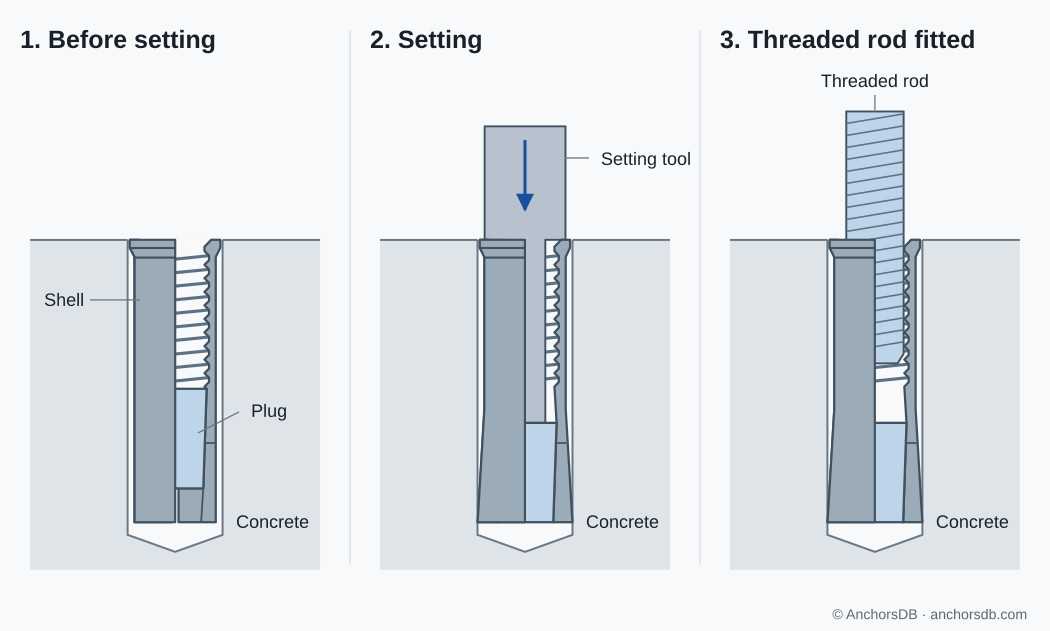
Figure 1. Drop-in anchor installation sequence.
The setting tool must match the make and size of the anchor. Setting is complete when the tool shoulder meets the shell or the tool leaves its setting mark, depending on the system. A drop-in anchor has no follow-up expansion: its resistance depends on full expansion during setting, and an incompletely driven plug reduces it.
Hole preparation and setting position
The hole diameter controls the fit between shell and concrete. The hole is drilled and cleaned as specified; drilling dust left in the hole can stop the anchor reaching its intended position.
The hole depth and shell position must match the installation data. A flanged version is held flush by its flange even in a deeper hole; other versions rely on the specified drilling depth. Because the anchor is set before the fixture is placed, it can be inspected before it is covered, and the fixture hole only needs to clear the bolt.
Bolt and threaded rod
The bolt or rod must have the specified thread, steel grade and material. It must engage enough of the internal thread without exceeding the maximum screw-in depth. Its length therefore allows for the fixture, washers and any packing: a short bolt leaves too little thread engaged, and a long bolt can bottom out before it clamps the fixture. The specified tightening torque limits the load on the shell and its thread.
A threaded rod suspending services is screwed to its full engagement before the supported component is connected. Such a rod does not clamp a fixture to the concrete.
Failure modes and resistance
Under tension, the resistance is limited by steel failure of the bolt, pull-out of the shell, concrete cone failure or splitting. With the short embedment of most drop-in anchors, pull-out and concrete cone failure commonly govern. Under shear, steel failure of the bolt, concrete edge failure or pry-out can govern.
Concrete condition and intended use
Setting produces splitting forces, so the minimum edge distance, spacing and member thickness in the European Technical Assessment (ETA) apply even to a shallow anchor.
For cracked concrete, drop-in anchors are often assessed only for redundant non-structural systems, such as suspended services, in which the load from a failed fixing is carried by neighbouring fixings. The ETA states the intended use, the concrete condition and the arrangement it covers; see cracked vs uncracked concrete.