

Corrosion reduces the steel cross-section that carries load, can crack the surrounding concrete as rust expands, and in some mechanisms causes sudden fracture with little visible warning. EN 1992-4 requires the material and corrosion protection of a fastener to be selected for the environmental conditions at the place of installation, taking into account whether the fastener can be inspected, maintained and replaced. The European Technical Assessment (ETA) of an anchor states the intended use of each material variant, such as zinc-plated steel for dry internal conditions only.
Exposure conditions and anchor materials
The informative Annex B of EN 1992-4 relates the anchor material to the exposure, assuming a working life of 50 years. National rules and the ETA take precedence where they give other provisions.
| Exposure | Examples | Anchor material |
|---|---|---|
| Dry internal conditions | Heated and ventilated interiors | Carbon steel; the zinc coating applied for storage and function is sufficient |
| External atmosphere or permanently damp internal conditions | Façades, unheated buildings, internal wet areas | Austenitic stainless steel with molybdenum, such as 1.4401, 1.4404 and 1.4571 (grade A4) |
| High chloride or sulphur dioxide exposure | Indoor swimming pools, road tunnels and car park decks with de-icing salts, seawater splash zones, flue-gas desulphurisation plants | High-alloy stainless steel with about 20 % chromium, 20 % nickel and 6 % molybdenum, such as 1.4529, 1.4565 and 1.4547 |
All metal parts of the fastener, including the bolt, nut, washer and any sleeve, should be of the same or a compatible corrosion-resistant material, to avoid galvanic corrosion between them. An anchor installed for a temporary purpose and left in place, or cut off flush with the surface, is exposed for the life of the structure and needs a material for that period.
Zinc coatings
A zinc coating protects carbon steel as a barrier and by sacrificial action: where the coating is damaged over a small area, the adjacent zinc corrodes in preference to the exposed steel. The coating is consumed at a rate that depends on humidity, pollutants and chlorides, so its life is proportional to its thickness. Electroplated coatings on anchors are typically 5–10 µm thick and are suitable for long-term use only in dry internal conditions; in an external urban atmosphere they can be consumed within a few years. Hot-dip galvanised anchors carry coatings of 40 µm or more and last considerably longer, but driving the anchor into the hole can strip the coating from the parts that bear on the concrete. The yellow or blue passivation applied over electroplating protects the zinc during storage only.
Stainless steels
Stainless steel is protected by a thin chromium-oxide passive film that re-forms when damaged, provided oxygen reaches the surface. Its resistance increases with the chromium, molybdenum and nitrogen content. Grade A2 (1.4301) has no molybdenum and is susceptible to local attack in chloride-bearing environments. Grade A4 (1.4401, 1.4404, 1.4571) is the usual material for anchors in external and damp conditions. High-alloy grades are used where chlorides accumulate on surfaces that are not washed by rain. EN 1993-1-4 classifies stainless steels in corrosion resistance classes CRC I to V, and current ETAs often state the class of each material.
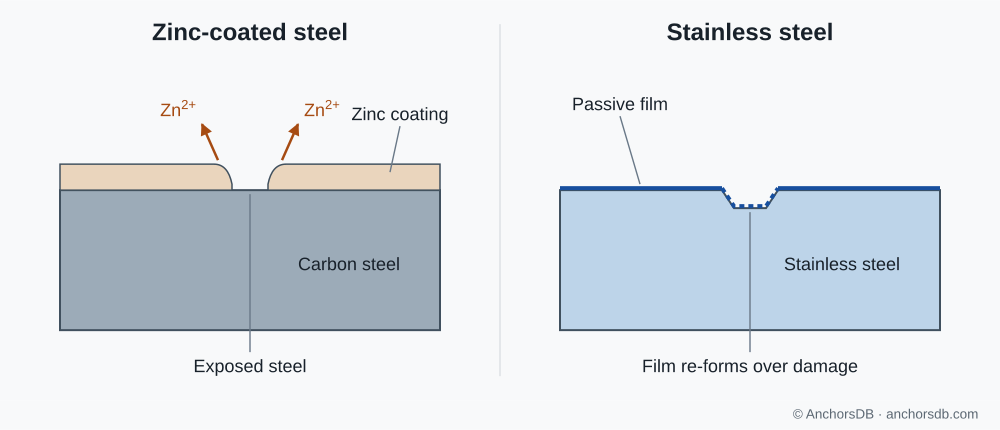
Figure 1. Corrosion protection of zinc-coated and stainless steel. Layer thicknesses are exaggerated.
Pitting, crevice corrosion and stress-corrosion cracking
On stainless steel, corrosion concentrates where the passive film breaks down locally.
- Pitting: chlorides break the film at individual points. A pit can have a small opening at the surface and a much larger cavity below it, so the loss of cross-section is underestimated by inspection. Particles of carbon steel from tools or grinding can also initiate pits.
- Crevice corrosion: in narrow gaps, such as between a washer and the fixture or under deposits of mortar and dirt, a chloride solution is held while oxygen cannot reach the surface to repair the film. Attack occurs inside the gap, where it cannot be seen.
- Stress-corrosion cracking: grades A2 and A4 under tensile stress can crack in chloride-bearing atmospheres, particularly at elevated temperatures. The stress may come from preload, applied load or residual stresses from forming and welding. The fine cracks are not visible and can lead to sudden fracture. Indoor swimming pool halls are the typical case; load-bearing fastenings there need high-alloy grades.
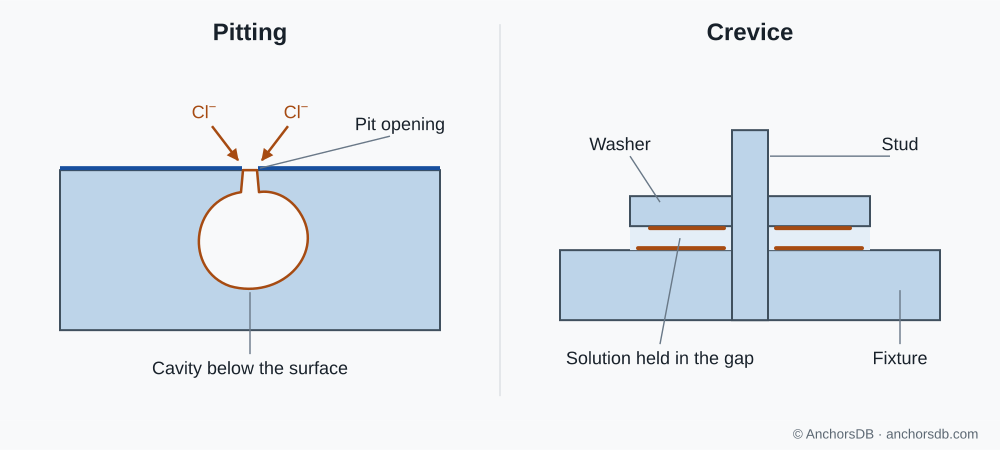
Figure 2. Pitting and crevice corrosion. Gaps and cavities are exaggerated.
Galvanic corrosion
Two different metals in electrical contact through an electrolyte, such as rainwater, form a galvanic cell. The less noble metal corrodes faster and the more noble metal is protected. In order of increasing nobility: zinc, aluminium, carbon steel and cast iron, brass, stainless steel. The effect increases with the difference in potential and with the ratio of the noble to the less noble surface area. A zinc-coated anchor in a stainless steel fixture therefore corrodes rapidly, while a stainless steel anchor in an aluminium or galvanised fixture has little effect on the larger fixture. Annex B of EN 1992-4 calls for galvanic corrosion to be prevented by compatible materials or by separation, for example with non-metallic washers and sleeves.
A stainless steel anchor in contact with reinforcement in an aggressive environment can accelerate corrosion of the reinforcing bars. The mortar of a bonded anchor separates the rod from the reinforcement.
Mortar of bonded anchors
Injection mortars generally resist chlorides and weak acids, and differ in their resistance to oils, solvents and strong acids. The manufacturer's data give the resistance of a particular mortar to specific chemicals. Exposure is limited to the mortar near the concrete surface, and damage there has a limited effect on the bond resistance over the full embedment.
See what an ETA records for material variants and mechanical versus chemical anchors for other selection conditions.